
How Fare Marketing Pages Help Airlines Turn Search Demand Into Bookings
Fare marketing pages can connect search intent with relevant routes, destinations and booking paths. Learn how airlines can use fare marketing pages to support discovery, SEO and conversion-focused travel journeys.
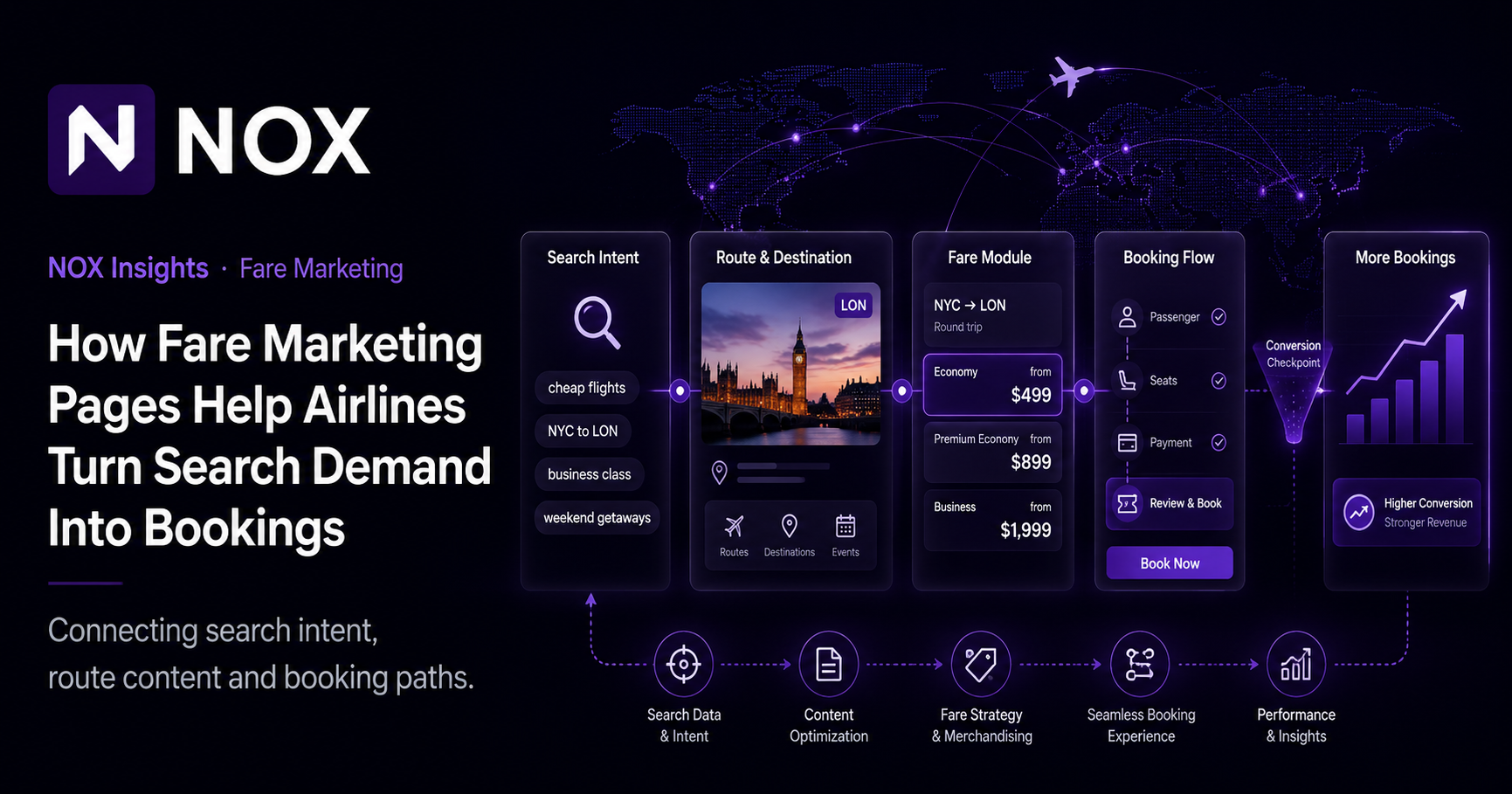
Connecting travel demand with useful digital journeys
Airlines often have more search demand than they realize. Travelers search for routes, destinations, seasonal trips, weekend escapes, beach vacations, business travel options, family travel, low fares and specific origin-to-destination combinations every day. The challenge is not only having demand. The challenge is connecting that demand to useful, indexable and conversion-focused digital experiences.
This is where fare marketing pages become important.
Fare marketing pages help airlines and travel brands connect search intent with relevant routes, destinations, fare content and booking paths. When they are planned correctly, they do more than display prices. They help travelers understand where they can fly, why a destination is relevant, what routes are available, what offers may apply and what action they should take next.
For airline digital teams, fare marketing pages sit at the intersection of Technical SEO, UX, content architecture, campaign execution and e-commerce. They are not just marketing pages. They are part of the booking journey. Fare marketing pages work best when route, destination and campaign content is structured in a way that supports users and search engines, aligned with guidance from Google Search Central.
“Fare marketing pages work best when they connect search intent, relevant content and a clear path toward booking.”
Why search demand alone is not enough for airlines
Many airlines already have strong demand signals. Travelers search for destination ideas, direct flights, seasonal routes, city pairs, vacation packages, low fares and travel dates. But that demand does not automatically turn into qualified traffic or booking activity.
A traveler searching for “flights from Miami to Cancun” may need a different page than someone searching for “best beach destinations from Miami.” A traveler looking for “cheap flights to New York in December” may need fare content, date flexibility and a clear booking CTA. Someone exploring “where to travel from Quito” may need destination inspiration, route options and internal links to relevant pages.
If the airline website does not provide a useful page for these different types of intent, the journey can break. The traveler may land on a generic page, a thin route page, a slow campaign page, a fare module without context, or a booking form that does not reflect the search that brought them there.
Search demand needs structure. It needs pages that match intent, content that supports decision-making and booking paths that reduce friction.
What fare marketing pages are
Fare marketing pages are digital pages designed to promote routes, destinations, fares, campaigns or travel opportunities while guiding users toward a booking action.
They can include:
- Route pages for specific origin and destination pairs.
- Destination pages focused on city, country or region discovery.
- Fare modules showing relevant prices, offers or availability signals.
- Campaign landing pages for seasonal promotions or route launches.
- Travel content hubs that organize destinations, routes and themes.
- Booking-focused CTAs that move users toward flight search or purchase.
The best fare marketing pages are not just fare displays. They combine commercial relevance, search visibility, useful content and a clear user journey.
A route page, for example, should not only say that an airline flies from one city to another. It should help the traveler understand the route, relevant airports, travel timing, destination context, fare availability, related routes and the next step to book. A destination page should not only describe a city. It should connect inspiration with route availability and booking options.
How fare marketing pages connect intent with booking paths
Fare marketing pages work because they create a bridge between what travelers search for and what the airline wants them to do next. Different page types support different stages of the journey.
Route pages
Route pages are usually the most direct connection between search demand and booking intent. They target searches that include an origin, a destination or both.
For example:
- Flights from New York to London.
- Direct flights from Orlando to San Juan.
- Cheap flights from Chicago to Las Vegas.
- Flights to Cancun from Dallas.
A strong route page should answer the user’s basic questions quickly: Can I fly this route? What destination is served? Where do I start the booking process? Are there related destinations or nearby alternatives?
Route pages also support internal linking because they can connect to origin pages, destination pages, fare modules, campaign pages and broader travel hubs.
Destination pages
Destination pages support discovery and inspiration. They are useful when travelers know where they want to go, but may not know the best route, dates or offer.
A destination page for Barcelona, for example, can include travel inspiration, airport details, popular travel periods, related routes, nearby cities, fare modules and CTAs to search flights. The goal is not to become a generic travel guide. The goal is to make the destination commercially useful inside the airline’s digital ecosystem.
Destination pages are especially valuable when they connect inspirational content with actual route availability and booking paths.
Fare modules
Fare modules help make fare marketing pages actionable. They can surface prices, route offers, promotional fares or dynamic fare content depending on the airline’s existing systems and configuration.
However, fare modules work best when they are placed in the right context. A fare module without clear headings, supporting content or relevant CTAs can feel disconnected. A fare module that loads slowly, shows irrelevant routes, displays mismatched markets or fails on mobile can damage the journey.
The module should support the intent of the page, not replace the page experience.
Campaign landing pages
Campaign landing pages are useful for seasonal promotions, route launches, market-specific offers, holiday campaigns and destination pushes.
For example:
- Summer flights to Europe.
- New nonstop routes from a specific city.
- Caribbean sale campaign.
- Holiday travel deals.
- Weekend getaway offers.
The risk is that campaign pages often become temporary, disconnected or duplicated. A campaign page should have a clear purpose, clean URL strategy, relevant content, campaign-specific CTAs, tracking considerations and internal links to permanent route or destination pages when appropriate.
Travel content hubs
Travel content hubs organize related pages around a theme, market or intent. They can help users explore multiple options while helping search engines understand how content is connected.
Examples include:
- Beach destinations from Florida.
- Best weekend trips from New York.
- Flights to the Caribbean.
- Ski destinations in winter.
- Routes from a specific origin city.
- Seasonal travel deals.
A hub should not be a random list of links. It should provide context, guide exploration and connect users to route pages, destination pages and booking actions.
Why SEO and content architecture matter for fare marketing
Fare marketing pages need to be discoverable, crawlable and useful. That means SEO is not just about keywords. It is about structure.
Airline websites can involve many URLs, markets, languages, routes, modules and campaign variations. Without a clear content architecture, pages can become difficult to crawl, hard to maintain and confusing for users.
Important SEO considerations include:
- Descriptive URLs that reflect the page purpose.
- Unique content for important routes and destinations.
- Clear headings that match user intent.
- Crawlable internal links between hubs, route pages and destination pages.
- Canonical strategy for duplicate or near-duplicate pages.
- Indexation control for temporary, low-value or parameter-heavy pages.
- Structured data where appropriate.
- Mobile-friendly page layouts.
- Fast loading templates and optimized fare modules.
Internal linking is especially important. A traveler should be able to move naturally from a destination hub to a specific route page, from a route page to related destinations, from a campaign page to available fares and from content to booking.
Search engines also need those relationships to be understandable. This is where Technical SEO and Performance Engineering become part of the same fare marketing conversation.

How UX affects fare marketing performance
Even if a fare marketing page ranks or receives traffic, the experience still needs to work for users.
A traveler arriving from search should immediately understand:
- Where they are.
- What route, destination or campaign the page is about.
- Whether the content matches their intent.
- What options are available.
- What action they should take next.
UX problems often appear when pages are built from components without a clear journey. The page may have a hero section, a fare module, some destination copy and a booking CTA, but the order may not match how travelers make decisions.
For example, a user researching a destination may need inspiration first and fares second. A user searching for a specific route may need route confirmation and booking options immediately. A campaign user may need the offer details, travel period and CTA before exploring supporting content.
Good fare marketing UX is not about adding more elements. It is about arranging the right elements in the right order for the user’s intent. That is why UX/UI Optimization is a critical part of improving booking-focused journeys.
Common problems that limit fare marketing pages
Fare marketing pages often underperform because the ecosystem is fragmented. Common problems include:
- Generic pages that do not match specific route or destination intent.
- Route pages with thin or duplicated content.
- Destination pages that do not connect to actual flight options.
- Fare modules showing irrelevant or poorly configured results.
- Campaign pages that disappear without supporting evergreen pages.
- Weak CTAs that do not clearly guide users toward flight search.
- Poor internal linking between related routes, destinations and hubs.
- Slow templates, heavy scripts or unstable layouts.
- Mobile layouts that hide important booking actions.
- Lack of personalization by market, origin, route, language or campaign.
- Too many similar URLs competing with each other.
- Missing QA across markets, devices or site editions.
These issues are not always caused by one team. They often appear when SEO, marketing, product, CMS, development and campaign workflows are not aligned.
What airlines should review before optimizing fare marketing pages
Before making design or content changes, airlines should review how their fare marketing ecosystem works today.
Key questions include:
- Which route and destination pages receive search demand?
- Which pages are indexable, and which should not be?
- Are route, destination, campaign and hub pages internally linked?
- Do fare modules show relevant routes, markets and prices?
- Are CTAs visible, clear and connected to the booking journey?
- Are pages fast enough on mobile?
- Is the content unique, useful and aligned with traveler intent?
- Are seasonal campaigns supported by evergreen pages?
- Are there duplicated pages or unclear canonical signals?
- Can CMS teams maintain the pages without technical friction?
This review helps teams move from isolated fixes to a more strategic operating model.
How NOX helps airlines and travel brands improve fare marketing pages
NOX helps airlines and travel brands improve the fare marketing systems and page experiences they already have. NOX does not sell a proprietary fare marketing product, build a booking engine from scratch or replace an airline’s existing commercial platforms.
Instead, NOX supports the technical and operational layer around fare marketing execution.
This can include:
- Optimizing route pages, destination pages and campaign landing pages.
- Improving fare module placement, configuration and page context.
- Reviewing technical SEO, crawlability, indexation and internal linking.
- Improving UX/UI structure for booking-focused journeys.
- Supporting content architecture for travel hubs and campaign ecosystems.
- Improving mobile performance and Core Web Vitals opportunities.
- Personalizing page experiences by market, route, destination or campaign.
- Supporting CMS workflows, QA and documentation.
- Helping technical, marketing and product teams align around implementation.
For enterprise airline teams, the value is not only in creating pages. The value is in making those pages easier to manage, easier to discover, easier to use and better connected to the booking journey.
What to do next
Airlines that want to get more value from fare marketing pages should start with a practical review, not a full rebuild.
A useful next step is to audit a representative set of pages:
- One high-demand route page.
- One destination page.
- One seasonal campaign page.
- One travel content hub.
- One page with a fare module.
- One mobile booking path connected from those pages.
Review each page for search intent, content quality, internal linking, module relevance, CTA clarity, mobile UX, speed and maintainability.
Then prioritize improvements based on business value and implementation effort. Some issues may require technical SEO work. Others may require UX restructuring, CMS cleanup, campaign governance, personalization rules or performance optimization.
The goal is to turn fare marketing pages into a connected ecosystem that supports discovery, decision-making and booking-focused journeys. For broader implementation support, explore NOX Services or Technical Consulting & Product Support.
FAQ
What are fare marketing pages?
Fare marketing pages are airline or travel brand pages designed to connect routes, destinations, fares, offers, campaigns and booking paths. They can include route pages, destination pages, fare modules, campaign pages and travel content hubs.
How do fare marketing pages help airlines with SEO?
They help by creating useful, indexable pages that match traveler search intent. When structured correctly, they can support route searches, destination discovery, internal linking and clearer content architecture.
What is the difference between route pages and destination pages?
Route pages focus on a specific origin-to-destination pair, such as flights from Chicago to Cancun. Destination pages focus on a place, such as Cancun, and may connect users to multiple routes, travel inspiration and booking options.
Why are fare modules important for airline websites?
Fare modules help make pages actionable by showing relevant prices, routes or promotional fare content. They are most effective when they are configured correctly and placed within a page that provides useful context and clear CTAs.
How can fare marketing pages support booking journeys?
They can guide users from search or campaign traffic to relevant content, route options, fare displays and booking CTAs. The goal is to reduce friction between discovery and flight search.
What problems limit fare marketing performance?
Common issues include thin content, duplicated pages, weak internal linking, irrelevant fare modules, slow page templates, unclear CTAs, poor mobile UX and disconnected campaign pages.
How can NOX help with fare marketing pages?
NOX helps airlines and travel brands optimize, configure, personalize and support existing fare marketing pages and systems. This includes technical SEO, UX/UI optimization, performance, content architecture, fare module support, QA and technical consulting.